

Special Exhibit | Here Lie Lilacs

As the culminating project of her time at Sager Braudis Gallery, University of Missouri student and gallery intern Erin McFarland has curated the Uprise Bakery exhibit, Here Lie Lilacs. As a double major in English and Art, Erin finds illustrating artistic connections to formative thinking and culturally collective ideologies vital. Here Lie Lilacs is an exploration of surrender in both the physical and the spiritual realm. Speaking to the philosophies concerned with consenting release and nonnegotiable surrender, which in conjunction communicate the beautiful limitations of humanity but also a path towards death acceptance, Here Lie Lilacs aims to provoke subconscious thinking about our own mortality. Bearing in mind her desire to incorporate literary symbolism, the title of the exhibition stems from a Walt Whitman poem entitled “When Lilacs Last in the Dooryard Bloom’d”, a romantic elegy to Abraham Lincoln. As an elegy, the poem not only laments death, but also conveys three stages of loss: expressions of grief and sorrow, praising of the idealized dead, and finally, consolation or solace. Whitman marries each phase with a botanical motif—rendering death an integral part of life, as flowers begin budding in the spring and die come winter. Choosing lilacs specifically though, the speaker ensures continued life for the dead as he lays a lilac sprig onto Lincoln’s coffin, symbolizing rebirth or regeneration of the dead. Given these literary conventions, the title Here Lie Lilacs elicits the sorrowful memory of elegy in tandem with surrender to the natural world. The four visual artists included in this show masterfully convey similar concerns as Whitman over a century later.
Inducing ideas of remorse, grieving, and memory, Hannah Reeves combines notions of remembrance and vanity through the sumptuous symbolism of the Victorian era. Her work often focuses on memorialization of the dead, so like Whitman she notes the innate human desire to continue life after death, if only through the collective memory of the living. In this exhibit, she showcases portraiture accompanied by either birds or flora, intentionally alluding to postmortem imagery and allowing the audience moments of uncertainty. These mysterious symbols flirt with death acceptance, begging contemporary society to rediscover release and acceptance.

Mike Sleadd’s aggressive pen and ink works invoke dark energies reminiscent of horror through both the depicted subject matter and contrasting line weight. Executing precise detail alongside the natural chaos of fluid ink, Sleadd demonstrates a defining balance between control and release. His intricate line work consumes central areas only to be surrounded by madness. In this way, Sleadd’s work extrapolates the significance of consensual surrender while also suggesting themes of fear and death through medium, application, and subject.
Santiago Olazábal, a Cuban artist and Santeria priest, depicts figures with violent paint strokes and a limited palette of black, red, and yellow. The Santerían religion developed out of Yoruba and their colonization by Roman Catholics, melding rituals of communion with their ancestors and deities with the Catholic appreciation of sainthood. Santeria inspires the entirety of Santiago’s work, which is evident in choosing to surround each figure with red dots, indicating activated pressure points key to the religion. As communicating with the dead is a role solely practiced by priests during rituals, Santiago’s work in this exhibit deals largely with trances and possession, or surrender to the dead themselves.

Shanlin Ye too surrenders control to her medium, but also determines central facial features with the utmost precision. Displaying select pieces from her Mask series illustrates human features as crucial to physical and emotional identity, for only the lower face is allowed full rendering while the eyes are either closed or missing, which arguably is the most telling feature of one’s identity. The lack of eyes also provides a possessed or sleep-like quality to the mask, which inevitably excites ideologies surrounding spirits, death, and dying. Her use of watercolor only amplifies this effect, for the juxtaposition between medium and the depicted form hint at an honest relationship with surrender. Ye demonstrates surrender to her medium through the chance edges of each mask, but in doing so also a clear understanding and acceptance of release from the tangible.
Death is inevitable, and each of these artists renders this fact differently; however, whether it be funerary practices, religious beliefs, a lesson in surrender, or the horror of nightmares, the four artists refuse modern ideology of death as innately bad. Humans have struggled with the brevity of our life since the dawn of time and often idealize memorialization—40,000 years ago cavemen first left handprints on the inside of a cave wall, long before pictorial cave painting and witch hunts for immortality and eternal youth began with ancient civilization. Yet, death and dying remain prevalent, only our tolerance and coping mechanisms have begun to fade. Here Lie Lilacs desires the elimination of death from the realm of taboo, and realignment of our end within the balanced arms of control and surrender.
Here Lie Lilacs will be showing at Uprise Bakery May 5th through June 2nd.
Share
Special Exhibit | By Any Other Name

What’s in a name? Is it a title, or a description, or a slur? A lighthearted alias? A branded pseudonym? A name, applied perfectly, expresses the true nature of the being. So, real and thorough understanding is necessary in order to aptly name someone or something. Determining one’s own true name comes only after exploration and development of honest self-knowledge. In history and folklore, this morsel of information can even grant someone power over another. We also see iterations of this in our current wider culture.
In the context of this exhibit, name represents every word or phrase ever assigned to a person to describe their existence. Name represents every attribute that became a classification from someone else mouth. Name represents every ugly thing you have been called and every kind word that shaped your personality.
Go placidly amid the noise an the haste,
and remember what pace there may be in silence.
As far as possible without surrender
be on good terms with all persons
Speak your truth quietly and clearly;
and listen to others
even the dull and the ignorant;
they too have their story
Take ownership of this power and determine your name for yourself. Be bold in your identity and trust your intuition. Know yourself truly and listen to others names earnestly. Name your friends. Name your enemies. Name your weakness. Name your strength. Make your name, so no one else needs to.
University of Missouri student Danniele Liles has curated an exhibit in Suite B to further examine this concept. By Any Other Name is the culminating project of her time as an intern with Sager Braudis Gallery, and is on display through the month of May, Saturdays 11-6 and by appointment. This exhibit showcases work by six different artists, each approaching self awareness in a unique way.
Argentinian artist Sofia Bonati illustrates strong female subjects suggestive of her own personal sense of narrative. Her work features soft but confident figure rendering combined with whimsically patterned backgrounds. Utilizing graphite, ink, gouache and other two-dimensional media, she combines assured portraiture and surrealist elements to create stunning pieces with incredible detail.
Emily Burns shares a similar subtle realism captured with graphite. She draws on nostalgia and pop culture as metaphors for the predisposition of civilization to repress and ignore difficult emotions. Her pieces blur reality and fantasy, mirroring the the way our cultural belief systems encourage us to mask unrest and imperfection in our lives.

Regarding this representation of society and self, American printmaker/painter/metalsmith Amanda Outcalt uses her intaglio process to explore the interplay between identity and community. Her prints embody personal struggle and growth, combining the everyday and out of the ordinary. Her unique use of plate shape in the intaglio process allows her to reconsider the environment around the etching after printing, affording an opportunity to mix media and create extraordinarily singular works.

Terrance Purdy uses a strong perspective and subtle photography to discuss identity through the lens of inherent adversity. His images explore the archetypes and influences integral in shaping the identity of African Americans, juxtaposing disconnect and struggle with careful art direction and symbolic imagery. Purdy’s work discusses the unyeilding will of Black Americans to create and maintain culture in the face of constant erasure and inequality.

Utah-based artist Stephanie Clark uses embroidery techniques with drawing and fabric to create her compositions. Skylar, included in this exhibit, is a unique brand of mixed media for the painter, featuring not only embroidery but an ethereal graphite portrait. Clark uses embroidery to elicit nostalgia and domesticity in telling the story of her life.
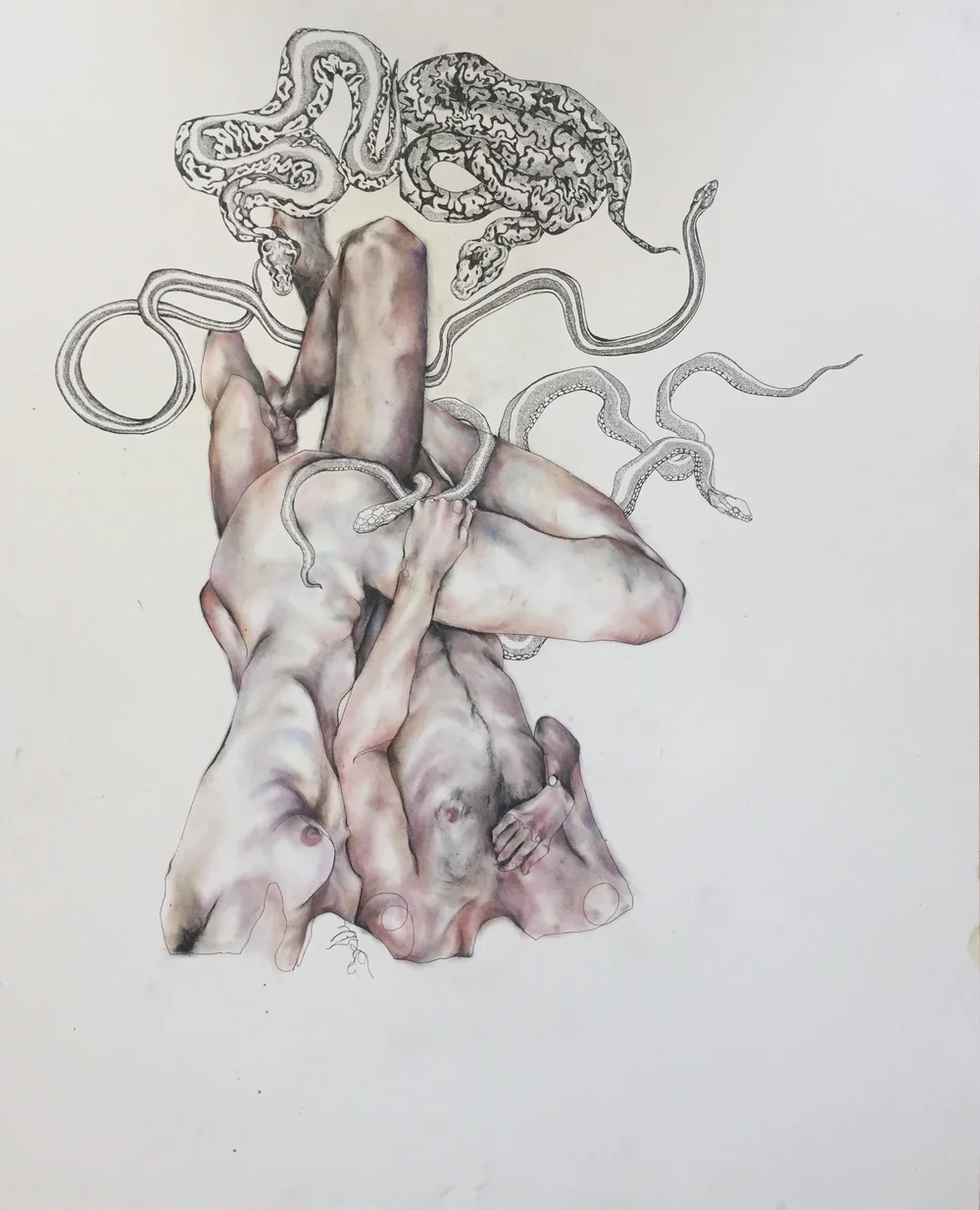
Tobi C’s piece, as the biggest work in the exhibit, acts as a sort of focal point. As the only gender non-conforming artist in the exhibit, they offer a different but important variant on the depiction of the figure. The artist continues the fantastical element seen in Bonati and Burns with the snakes and the rendering of the skin, but they add a unique, dysmorphic element into the figure that isn’t seen in any of the other pieces. The artist uses oil and ink on paper to combine figure and snake, civilian and barbarian, commenting on human nature and its relative closeness to the brutality of the animal kingdom.
While diverse, the works in his exhibit all convey the control and care of the artist over their message, with each one of the artists boldly claiming (or reclaiming) a certain territory. By Any Other Name brings these works together to show the power of that sense of ownership.
Special Exhibit | Don’t Wait for Me

Sager Braudis Gallery intern and University of Missouri student Alicia Jacobs curated Don’t Wait For Me in the gallery’s expansion as the culminating project of her internship. In addition to being involved in the full range of gallery operations including research, writing, and marketing, Jacobs has, during her internship, been able to apply a unique perspective to the gallery and develop her own curatorial voice, reflecting on what she has found most important, communicative, and effective in a collection of artwork. In the exhibit and in her blog post, Jacobs shares her thoughts and connecting thread between a diverse group of works by five artists: Alejandrina Herrera, Alexandra Levasseur, Andrea Wan, Sali Swalla, and Sofia Bonati.
Alejandrina Herrera blends expression and illustration in her work, focusing on bringing memory to the forefront as she asks her viewers to connect with the work and their experience of it. Alexandra Levasseur, too, brings a reflective psychology to her work, but takes a different route by exploring ideas of Surrealism. Levasseur melds the classical and statuesque with more naturalistic and active forms, creating multidimensional figures who embrace and interact with their environment. Rather than focusing on the natural environment and how that relates to experience, Andrea Wan uses her work as an expression of her personal experiences by tapping into her own subconscious and drawing inspiration from individuals around her seeming to tell stories that originate in her imagination. Finally, abstractionist Sali Swalla, unlike the previous artists who arrange their work in a more cerebral manner, expresses her inner thoughts and experiences with pure composition, color, and form. Swalla’s technique of layering and scraping away paint serves as a metaphor for personal growth and expresses a sense of longing and loss. The work of Sofia Bonati can be seen as a foil to Sali Swalla’s artwork as the themes of Bonati’s work are much more confident and confrontational. Her artwork uses a variety of media to create lively and decorative backgrounds that accentuate strong, complex characters.

Don’t Wait For Me is a collection of work that unites the concepts of assurance and uncertainty resulting in the acceptance and celebration of the personal journey. Drawing from personal experiences, Jacobs believes that surrounding oneself with individuals that exude confidence, assurance, and power can be great for motivational and positive influence. However, it is important to note that those individuals may not have started in that position. What may seem like a blissful and effortless course may have been a tumultuous and draining journey that led them to where they are now. Often times, one person’s success is seen as superior to another person’s journey that is still in progress. It is important to showcase all varieties and stages of growth and achievement because one’s process and approach can be just as important as ultimate success. If things do not go your way, that does not define you, it helps create you. Realize that wherever you fall, that placement is admissible. The artists in this exhibit vary in media, technique, and concept, yet when juxtaposed with equal standing, they dismantle the hierarchy between the celebration of the successful and the pitying of those still making progress, resulting in an environment that embraces all parts of the journey. This exhibit intends to celebrate the various perceptions of the personal journey by creating a space where each viewer can reflect on and accept their individual path and confidently say Don’t Wait For Me.

This exhibit will be on view in the expansion of Sager Braudis throughout May, and will be celebrated on First Friday, May 3rd, from 6-9pm, and Slow Art Saturday, May 4th, from 11-2pm.