

Featured Master | Dorothea Tanning

Each December, Sager Braudis Gallery brings significant 20th-century masterpieces to Columbia, Missouri for the Masters Exhibit. This year’s exhibit features women of Surrealism and Abstraction, who may just be the most important names in modern art history that you’ve never heard. In keeping with a current trend among museums and galleries worldwide, we’re shedding light on the work of these master painters for whom credit is long overdue. In the coming weeks, we’ll feature each of the 6 masters of the exhibit here on our blog, as well as in a 3-minute radio spot on our NPR affiliate, KBIA. Watch for the launch of our podcast, Portrait of the Artist, in which we’ll also discuss the artists of the Masters Exhibit, in early December. This week, we’re featuring painter Dorothea Tanning.
Dorothea Tanning was born in 1910. She lived to be 101, and painted for a solid 8 decades. Tanning was one of the only American-born Surrealists. In fact, she was Midwestern, born and raised in small-town Illinois and educated in Chicago. Tanning was already making a living through a combination of freelance commercial painting, fashion illustration, and fine artwork when she first encountered Surrealist works in 1936, at the MoMA. In 1943, curator and arts patron Peggy Guggenheim included Tanning in the groundbreaking exhibit entitled “31 Women.” This was alongside other greats of the era such as Frida Kahlo, Leonor Fini, Leonora Carrington, and Meret Oppenheim. Tanning met the Surrealist painter Max Ernst around this time, and married him in 1946. Tanning and Ernst lived and worked together in Arizona and then in France until his death in 1976, after which she moved back to New York.

Tanning had a very smooth, almost straightforward way of depicting surreal scenes. Her paintings are often like dreams that are so realistic that you almost cannot tell they’re dreams but for an oddness of perspective or slight stylization. Even her highly abstract, later works seem like photographs of colorful, nebulous forms.
Including Dorothea Tanning in an exhibit of all women masters of the 20th century, while appropriate, is also complicated. Though Tanning herself disliked discussion of her gender, and was resistant to the very term, “woman artist,” we think it matters that she created numerous masterpieces right alongside some of the biggest names in art history and yet was not granted the same recognition as these men. There is still work to be done, when Max Ernst is a household name but Dorothea Tanning is not. The art critic Soo Kang has said, “ Tanning never intended to make a feminist statement through these images. Yet, as she genuinely focuses on on her own dream images and discloses the unconscious mind, she inevitably expresses the voice of a woman. To do otherwise would be a fallacy in representing her inner world.” She used a Surrealist method, but dreamlike, female forms are different when coming from a woman painter, because instead of mere objects of gaze, her female subjects were protagonists, representing the fertile mind of the painter, rather than mindless muses.
Featured Master | Leonora Carrington
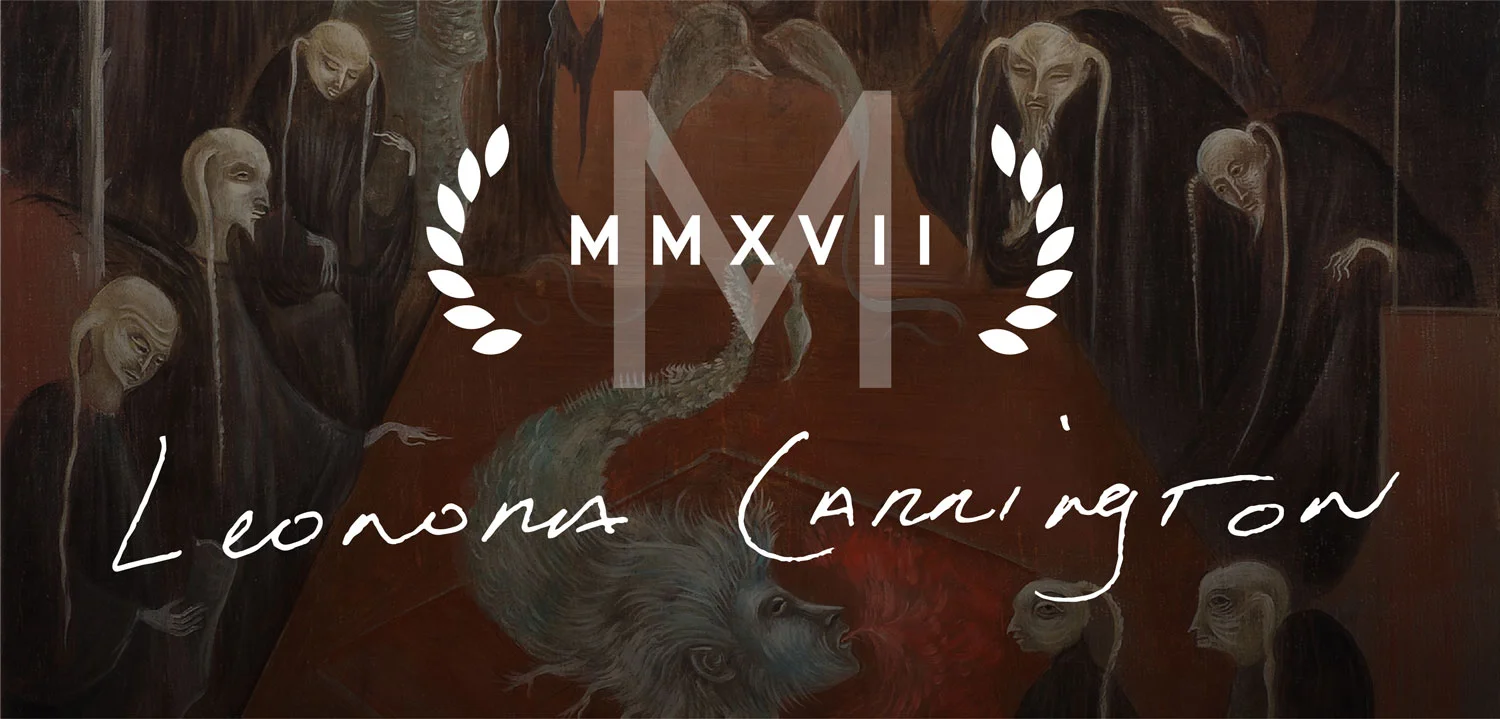
Each December, Sager Braudis Gallery brings significant 20th-century masterpieces to Columbia, Missouri for the Masters Exhibit. This year’s exhibit features women of Surrealism and Abstraction, who may just be the most important names in modern art history that you’ve never heard. In keeping with a current trend among museums and galleries worldwide, we’re shedding light on the work of these master painters for whom credit is long overdue. In the coming weeks, we’ll feature each of the 6 masters of the exhibit here on our blog, as well as in a 3-minute radio spot on our NPR affiliate, KBIA. Watch for the launch of our podcast, Portrait of the Artist, which will also feature the artists of the Masters Exhibit, in early December. This week, we’re talking about painter Leonora Carrington.
Leonora Carrington lived from 1917 to 2011 and painted prolifically from her art school days in the mid-1930s up until her death. She was affiliated with the early Surrealist circle in France, and fled Europe, like many artists, at the start of WWII. Unlike most of her peers who immigrated to New York around 1941, she went to Mexico, where she would spend the majority of the remainder of her career.
She has been called “the Reluctant Surrealist.” She was part of the movement at its peak, and her work clearly visually converses with other Surrealist masterpieces, but her approach to fantastic subject matter was different than that of her peers. While Breton, Ernst, and Dalí revered Freud and sought to manifest the subconscious, Carrington consciously infused her work with symbolic mythology. Her Surrealism was not stream-of-consciousness or dream-state; it was magical realism. Carrington’s painting is characterized by female protagonist subjects, animal-human chimeras, and allusion to magic and ritual. Her palette is dark and saturated, lending depth to elaborate, active scenes.
Women of the era who wanted to be professional, studio artists had to push against prescriptions for what kind of people they could be, and for what kind of artists they could be. Male Surrealists may have allowed women like Carrington into their circle, but not without framing them as muses, and expecting a level of subordination. Not only did Carrington create numerous, deeply symbolic masterpieces over a decades-long career – but she did so while under constant pressure to conform to the social constraints of her gender, and to male-defined, Freudian parameters of Surrealism.
You can see original works by Leonora Carrington at the 4th annual Masters Exhibit, on view December 1st – 30th, 2017.

Featured Artist | Peregrine Honig
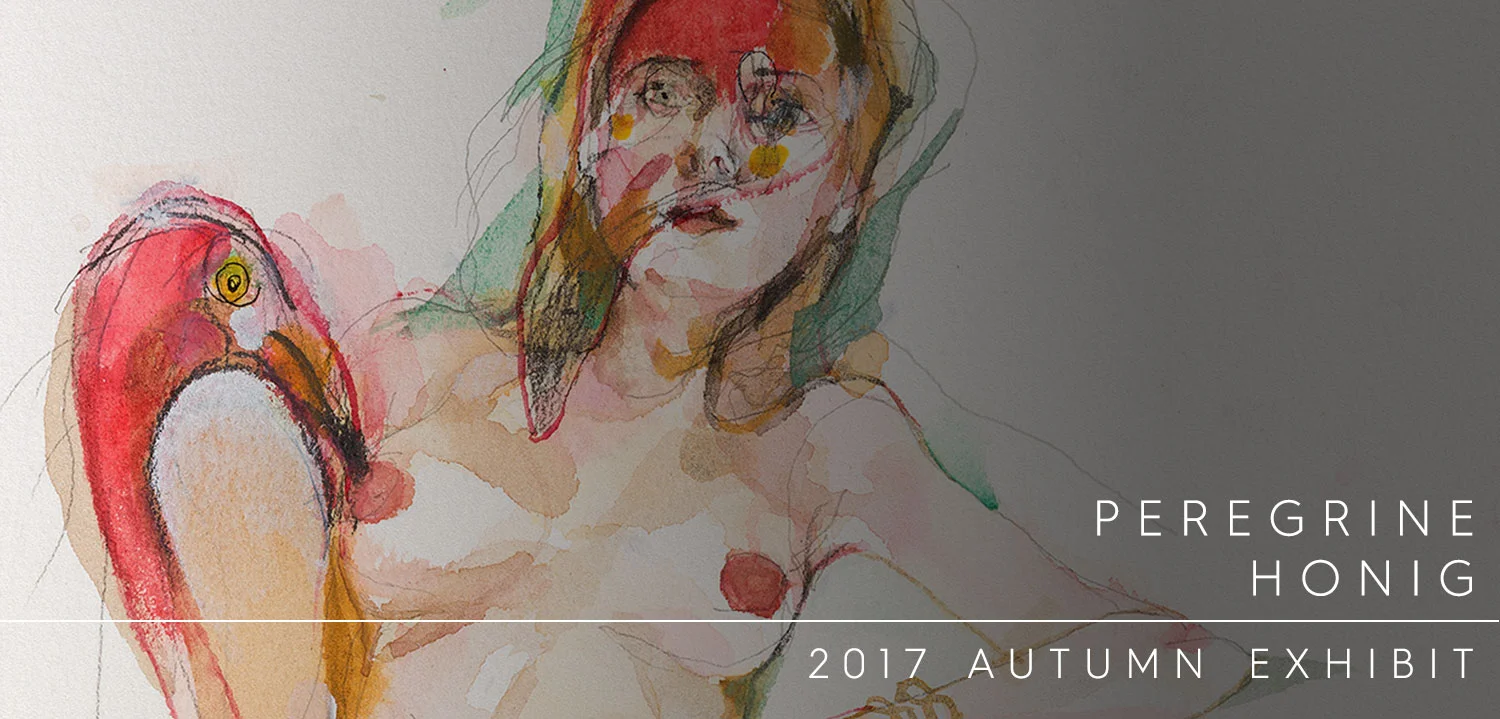
Written by Kat Cua, MU Sager Braudis Intern, Fall Semester 2017
Peregrine Honing as always been ahead of her time.
Born in San Francisco and raised in its Castro District, Peregrin Honig moved to Kansas City, Missouri, by herself at 17 to attend the Kansas City Art Institute. At 22, she became the youngest living artist to have work acquired by the Whitney Museum of American Art’s permanent collection. Other public collections that collect her work include Ball State University Museum of Art, Yale University Art Gallery, the Fogg Art Museum, Milwaukee Art Museum, and the Art Institute of Chicago.
After moving to Kansas City for school, Honig expected to get in and get out. She told Alive Magazine that at the time, she had never been to the Midwest, so she expected Missouri to look like what she saw in the Wizard of Oz and Meet Me in Saint Louis. She thought there, she’d complete her “rural residency” and then move to a coast.
“I was incorrect,” she says. “I fell in love with Kansas City.”

Honig now lives in and works out of the old Greenwood Baptist Church in KC’s Westside neighborhood. She restored the building from its decay and transformed it into both a private residence and public project space. Honig is an incredibly prolific artist. Artwork is scattered all over this space leaving no part untouched. Drawings sit stacked on the floor while other works cover the walls.
Working primarily in drawing and painting, Honig’s body of work spans 17 projects. In them, Honig explores themes of beauty, sexual vulnerability, and exploitation, and her work shown in the Sager Braudis Gallery Autumn exhibit is no exception. Her intaglio suite depicts acquiescent mother-proxies unnaturally fostering infant animals, which create disquieting, exploitative images presented under the guise of innocence. Her mixed-media figural work depicts a sort of hybrid being—a cross between human and animal. These recumbent nudes clearly call upon classical aesthetic and Greek mythology’s use of sexuality and maternity across species. Ultimately, these works force Honig’s viewers to consider a possible link between nurture and surrender.

Honig has also been prolific in her work outside of the studio. In 1997, she created an artist-run space called Fahrenheit Gallery in KC’s West Bottoms where nationally and internationally known artists are shown. In 2010, she appeared on the reality TV show “Bravo’s Work of Art: The Next Great Artist” where she was a finalist. As a way to support herself financially, she runs Birdies, a lingerie and swimwear shop in the city’s Crossroads District with her friend and business partner Alexis Burrgrabe.
“I co-own the business because I don’t want to have to think about money when I’m in my studio,” Honig told Alive. “I’m not interested in being a starving artist. That’s a debilitating way to think about yourself, and I think it’s unfair. It’s condescending and patronizing, and I think it allows for academics to look down on people who are producing the optical seeds that might save the world on a scientific level.”
Honig’s work has been on view since October, in her first exhibit with Sager Braudis Gallery, and will remain available through the gallery for a short while after the show comes down, at the end of the day Saturday. Those interested in seeing more should visit Honig’s Artist page on the gallery site, or contact the Gallery Director at hannah@sagerbraudisgallery.com.
Special Exhibit | As I Am

MU intern Kat Cua curated the hall exhibit titled As I Am, the culminating project of her time at Sager Braudis. The exhibit features work by artists Laura Baran, Jarvis Boyland, Helen Hawley, and Simon Tatum, each of whom created portraits that document real-life individuals, most of whom the artist knows personally. Kat sought to use this exhibit as a way to combat the toxicity of the all-too-prevalent cultural norm of exceptionalism, reacting to the way it affects marginalized communities in particular. Exceptionalism deems people worthy and grants them visibility only when they are the most exceptional at whatever service they are able to provide, stripping individuals of the luxury to make mistakes and the comfort to be unremarkable. Exceptionalism only accounts for those who are the absolute best, failing to recognize that every human is worthy and valuable simply because they exist. Kat chose each of these portraits for its documentation of real people and its elevation of the everyday and celebration of the ordinary as opposed to the spectacular.
Helen Hawley, born in Missouri, now lives and works in Madison, Wisconsin, where she teaches drawing at Beloit College. She graduated from the Rhode Island School of Design and the University of Wisconsin-Madison where she received a graduate fellowship. Hawley’s multidisciplinary projects include sculpture, painting, artists’ books, prints, performance, and video. In this exhibit, Hawley is showing a monotype and oil paintings on paper that date back to 2009 and 2010 respectively. These quiet images depict candid portraits in domestic interiors, their soft and indistinct edges suggesting that little separates the interior body from the space it inhabits.
Laura Baran, born in New Jersey, now lives and works in the Hell’s Kitchen area of New York City. She graduated from the Fashion Institute of Technology in New York with a BFA in illustration. Baran is a figurative painter of portraiture and landscapes, drawing on her emotional responses to her surroundings to create her work. In addition to her painting, Baran also creates illustration work for national clients. In Baran’s paintings for this exhibit, she celebrates the functionality and beauty of everyday people, revealing a narrative of inspiration in the ordinary.
Jarvis Boyland is a painter who lives and works in Chicago, Illinois. He was born and raised in Memphis, Tennessee, where he also attended the University of Memphis and earned his BFA in painting. In his studio practice, Jarvis navigates the intersectional tropes of blackness in his paintings, drawing on his experience as a southern black gay male as well as his rejection of his conservative upbringing. Girl with the Hoop Earrings works to situate, centralize, and celebrate the black femme within the long history of portraiture, one that is largely white.
Simon Tatum is a multidisciplinary artist from the Cayman Islands who’s concerned with the local-global negotiation of visual culture and historical dialogue and questioning how local populations absorb global influences through visual media and inherited objects. In his work, Tatum challenges the appeal for marketable subjects and interrogates, analyzes and traces the global lineage of visual devices that are significant to the Cayman Islands such as religious symbols, post-mortem mementoes, documentary photographs, and tourist advertisements. Tatum’s work Miss contains two portrait drawings on paper. These drawings were made by rendering an original screen print transfer that was taken from an image in the Cayman National Archives called “Unidentifiable Caymanian Woman.”