

Featured Artist | Kensuke Yamada
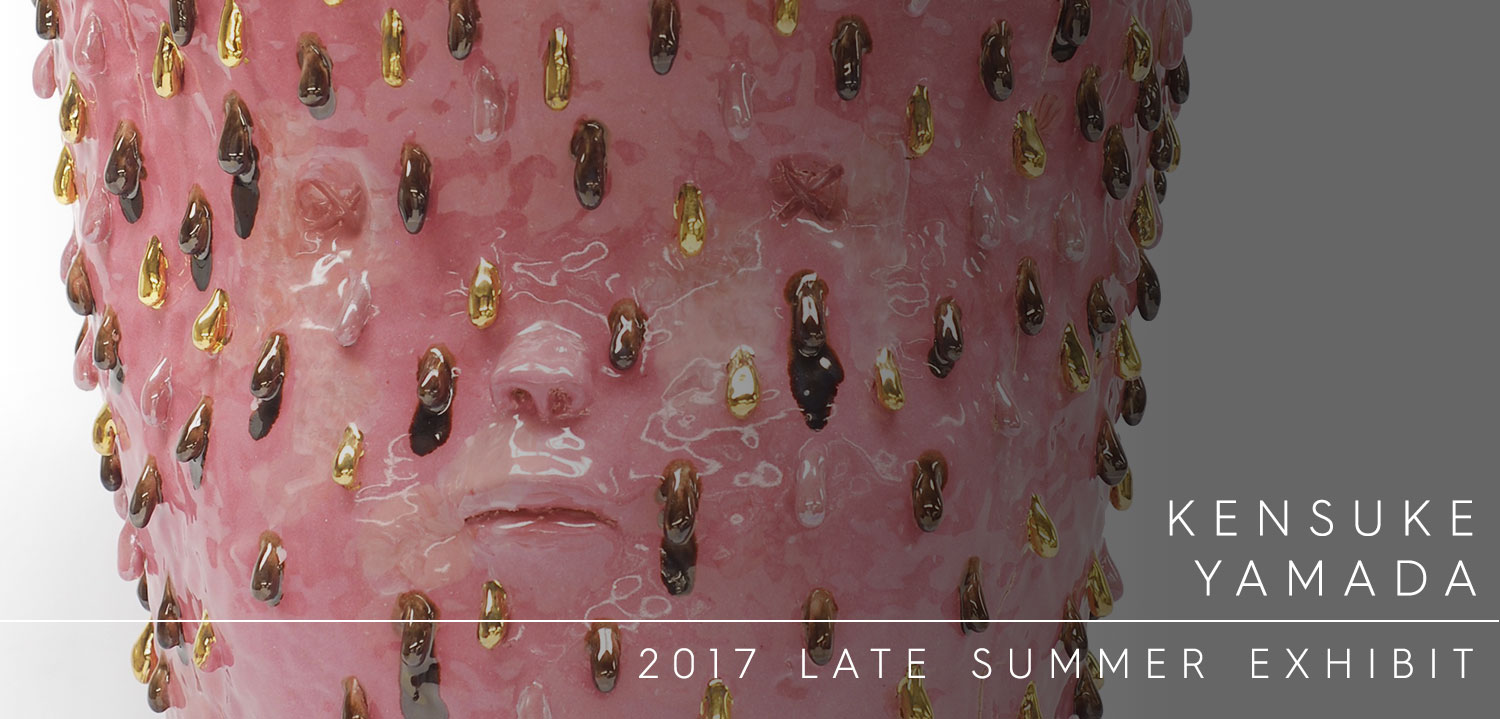
REEVES: Could you help those of us without a ceramics background to understand your processes, such as how your construction, glazing, and firing work?
YAMADA: I make sculptural ceramic pieces using a coil-building method. I fire my pieces multiple times using slip, glaze, stain, and oxide to create depth on the surface of the sculpture.
The way I see clay sculpture is, I am building a three-dimensional canvas that I will paint. Each layer of coils and touch is very important to me, to have a strong canvas to paint.

REEVES: Much of your work implies a narrative; it seems like many of your figures are characters, captured mid-story. Is there a narrative, in your mind, that surrounds the Heads in this series?
YAMADA: I always seek for the universal language to engage with people. People play sports, sing songs, dance, read and write to express themselves. I happened to meet art and ceramics, and those became my language to express myself.
Using ceramics and child-like figures as my platform, I express common feelings and emotional stages in everyday life.
REEVES: Your rendering of figures and heads with exaggerated proportions but dainty features makes me think of dolls, and there seem to be some other references to childhood iconography in this work as well. Could you talk about that a bit?
YAMADA: When I came to the states, my English was limited and I had to find different ways to communicate with people. Art was one of the ways I used to communicate with people.
I look for common things that I and you can share. Use of child-like figures and heads are the main objects I use to set common ground with everybody to share feelings and thoughts.

REEVES: Your methods are time-intensive, and yet you are very productive, often showing new work multiple times a year. What are your studio practices or habits that affect such productivity?
YAMADA: Working with clay or making art, I re-think who I am through the process. It is like the way we can identify our own handwriting. I practice the process of making art to learn about the way I process and organize materials; to see who I am.
Material “clay” is a living thing. It will die once when it dries, and I revive it using fire. I am working with clay, not using clay. I go to my studio pretty much everyday.
The more I spend time in my studio, I learn more about who I am through the way I work.
REEVES: I always like to ask: What is your studio quirk?
YAMADA: I have multiple pieces going on in my studio.
I always have pieces be ready for an upcoming deadline. At the same time, I always have an experimental piece I am pushing, to make a change from the current work, on the side.
The studio is very private space to me. For example, people can invite others to their living room to hang out, but we do not invite everybody to hang out in our bedroom. I like my studio to be very private.
Featured Artist | Jessica Keiser
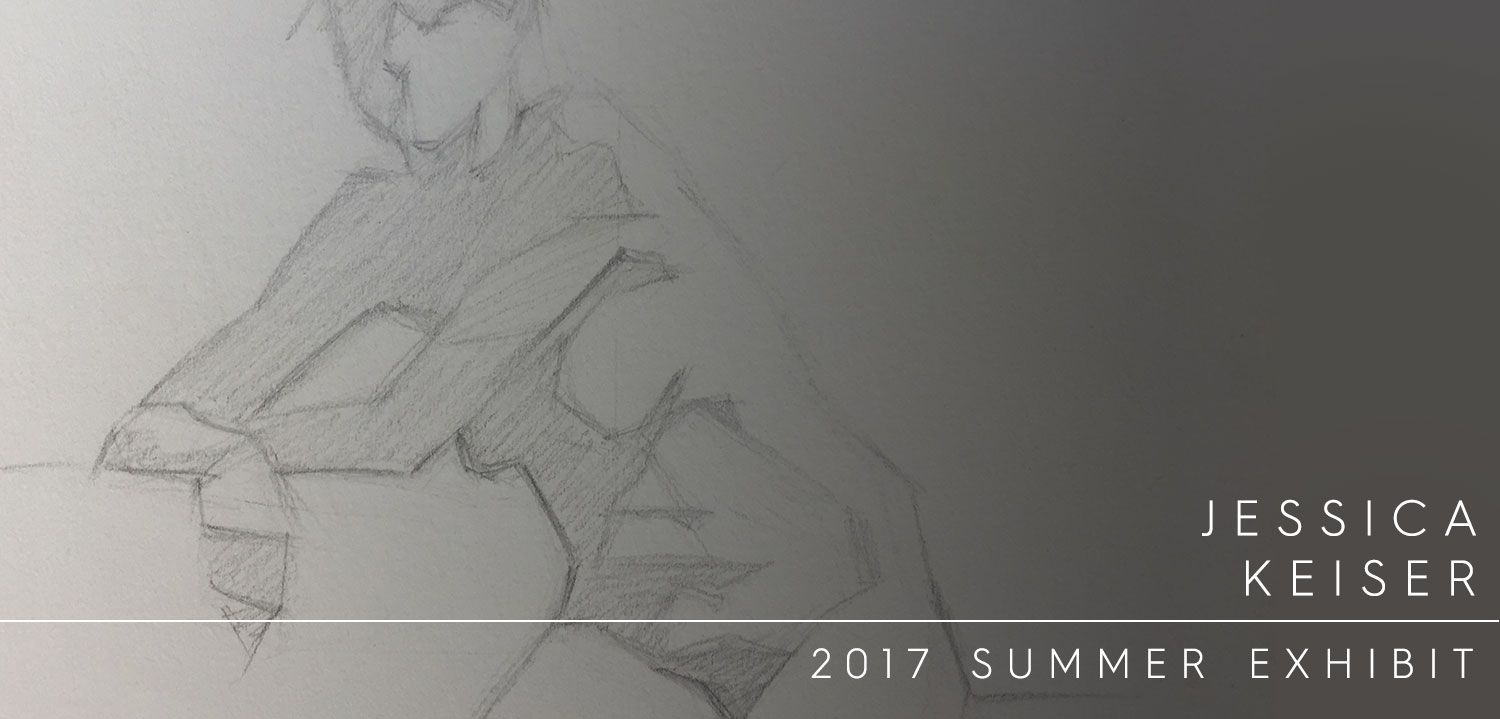
An educated painter and recent PhD in Philosophy, Jessica Keiser is a returning exhibitor at Sager Braudis Gallery this summer. Whether in dry media on paper or oil on canvas, Keiser draws on traditional technique and an intuitive understanding of anatomy to convey the human form with stunning accuracy. Keiser discusses her life and work in this interview with Gallery Director Hannah Reeves. Her work will be on view in the Summer Exhibit through July 29th.
REEVES: First of all, you’re finishing your PhD, and the admirers of your work who learn this almost always ask, “How does she have time to make art?” So, I know that’s a common question, but what does your studio schedule look like? How do drawing and painting fit into your life right now?

KEISER: The honest answer is that the lack of time and space is a huge problem, and I only manage to fit drawing and painting into my life with a lot of violent pushing and shoving. My studio schedule has been very erratic for the past few years; I work in panicky fits and starts, doing as much as I can before I feel that I need to focus exclusively on my writing again in order to briefly gain control of my life. And then I start it up again until I get stressed out, then take another breather, etc. I can’t simultaneously give them both the attention needed to produce my best work, and that causes me a lot of guilt and anxiety.
Also, my “studio” is currently the living space/bedroom of a small studio apartment which I share with my partner. When I am working on a project, it degenerates into an unmanageable state, with a layer of charcoal dust on the furniture, gummy erasers squashed into the carpet, easels, drawing boards and other large obstacles blocking the doorway, etc. It’s one reason why I have been doing more drawings than paintings lately.
REEVES: For you, what is it about the human figure that keeps you returning to it as subject matter?
KEISER: That’s a good question, and I’m not sure I have an answer that won’t sound trite. I guess there is a subtle pathos in an image of a solitary figure that I find irresistible. I think there’s also an indirectness in the process which fascinates me: I feel like I am trying to capture something I see on the surface—both physically and emotionally—which is caused by something underneath that I don’t understand or have access to. For instance, I’ll want to capture a look on someone’s face that has a certain emotional tenor, but I don’t know precisely what it is or what caused it or when it will change. Or I’ll want to capture the interaction of warm and cool colors on the surface of the skin, which is an effect of the blood in their veins, the quality of the afternoon light, and other things that I don’t see directly. Or the landscape of the skin which is produced by the underlying structure of sharp bones, soft tissue, and whatever else goes on under there. (I was a bad anatomy student.)
REEVES: Is your artwork related to your writing? Does one medium influence the other?
KEISER: My artwork is related to my writing in that it keeps me from doing it, hehe. I work in philosophy of language, and I wouldn’t say that it has changed the way I paint and draw, but it has helped me to understand what I am doing a little bit better. I think and write a lot about communication broadly speaking, and that has helped me tease apart differences between the mechanics and goals I use in ordinary linguistic communication vs. the audience-directed intentions I have when making a painting.
My artwork hasn’t seriously impacted my writing yet, but I think that will change after my dissertation is over and I have more freedom to pursue other projects. I have a good friend who studies the way biases and beliefs influence perceptual experience, and we are toying around with writing a paper together about how this relates to the experience of making and viewing artwork. So I can see doing more work at the interface of philosophy of art/language or philosophy of art/mind, and my experience as an artist would definitely be relevant there.

REEVES: Do you have an art-world hero?
KEISER: It’s funny, I think I have more literature-world heroes than art-world heroes. Maybe it’s because I approach art differently as a practitioner than I otherwise would. I cast a broader net; what I learn from, what moves me, comes from such a scattered range of sources, without one being particularly encompassing.
But I guess I have a lot of heroes here and there. They tend to be people whose work exhibits skill that is borne from struggle. Work that seems to be driven more by an unrelenting internal drive than an external one. By that I definitely don’t mean that they aren’t deeply influenced by others, but that ultimately their work is a manifestation of chasing their own demons, rather than a struggle to earn social capital. Two heroes that come to mind are my former schoolmates Jordan Sokol and Roald Sivertsen.
REEVES: I always like to ask: What is your studio quirk?
KEISER: I’m not sure if this qualifies as a quirk, but I visually take in information far away from my easel, and so the process of drawing tends to involve a lot of walking backward and bumping into or tripping over things. I also look at my subject through a hand-held mirror (in order to change the way I perceive it by making it less familiar), and this probably seems a little bizarre to the outside observer.
Featured Artist | Carrie Shryock
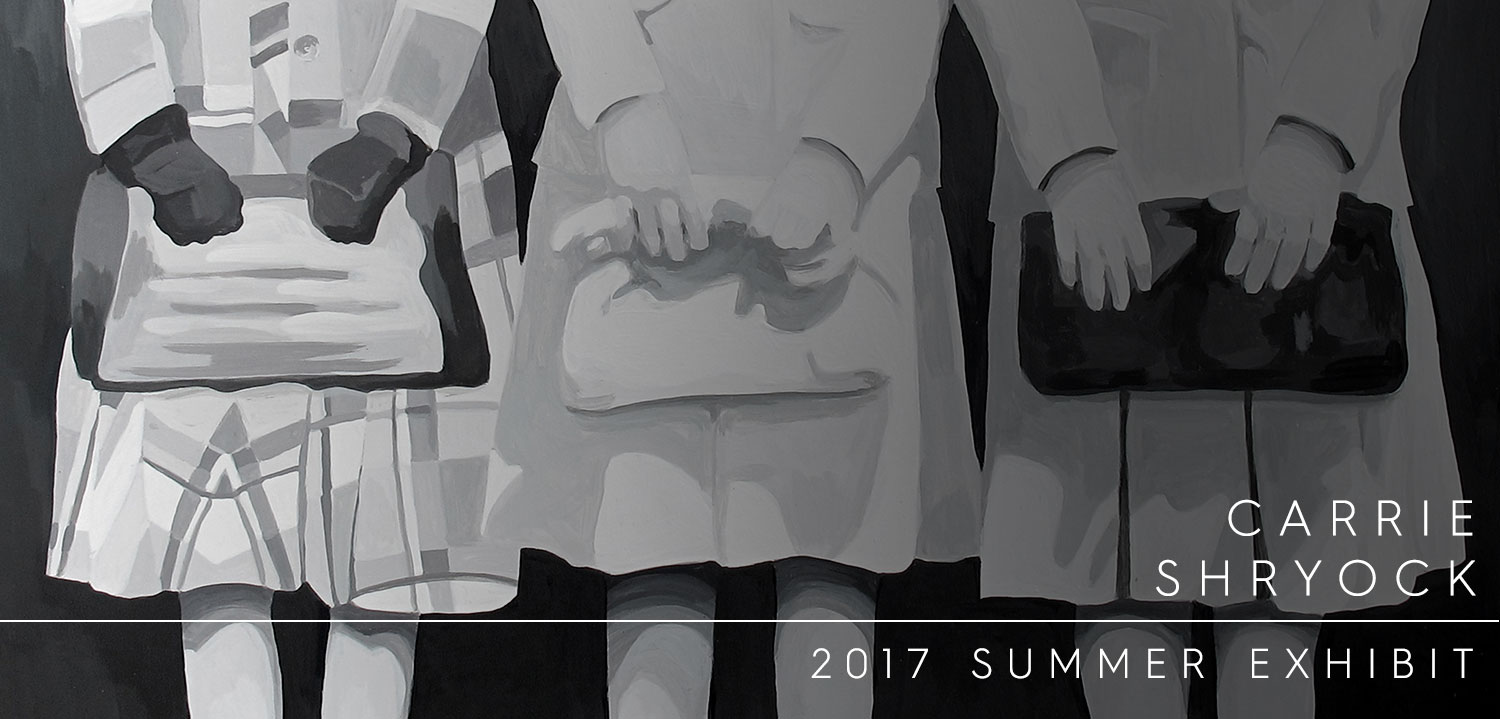
Carrie Shryock was born and raised in Missouri, and her history here – both personal memories and inherited connection to the land – is documented and celebrated in her painting. There’s a vulnerability to the open-sketchbook presentation of her landscapes, just as there is in the public presentation of a candid family photo, that endears viewers who share Shryock’s inclination toward preservation and rootedness. Gallery Director Hannah Reeves asks the artist about her background and process in this Featured Artist interview. Shryock’s work will be on display in the Summer Exhibit through July 29th.
REEVES: Our visitors have been fascinated with your mounted, open sketchbook series, Nephology. How did you arrive at the idea to present your landscape painting in this way?
SHRYOCK: These paintings in sketchbooks started a couple of years ago. At the time I was in a job where I was doing a lot of design work. I was spending all of my time creating illustrations against deadlines, and working on product driven artwork – stuff that would be sent to the printer the following week. I enjoyed what I was doing, but I also recognized that the cyclical nature of that process was taking a toll on my creativity. I decided I needed a personal project, something that I could work on without feeling pressure from so many forces outside of myself. I began painting these landscapes, based on the views outside my backdoor, the big Missouri sky, and other scenes around the area where I live, and before long I had filled up a couple of books. It was something that I could fit in around all of my other weekly demands, and it was different enough from what I was doing during the rest of the week that it really helped to feed my mind and sustain my creativity. It’s really interesting to look back through those books. I can remember what I was thinking about, and what I was looking at as I painted each one. They are a diary of sorts, documenting changes in myself, and changes in the landscape, and I guess that’s exactly what a sketchbook should be.

REEVES: I understand that the images for your black-and-white paintings are from a family album. Could you tell us about choosing these antique photographs to paint?
SHRYOCK: Those paintings are all based on photographs in one of my grandma’s photo albums from the 1940s. She was born and raised in the Hatton, Missouri area, which is also where I was raised, and where my family still lives and farms. During WWII, when every single young man in the community was away fighting in the war, she and her friends took it upon themselves to be the glue that helped to hold the community together. They kept in contact with all of the boys that were away, and on a weekly basis they sent a newsletter from home to each of the boys, wherever they were, with news of what was happening back in Hatton. The boys would write back with stories and news of where they were and what they were doing, and everyone looked forward to getting those letters. It’s an amazing story, with so many details that are almost unbelievable. Even though I know it was a really hard time to live through, I have always loved hearing my grandma talk about it, and the photos from that time seem so enchanting. It’s a family story that I love, but every family has similar stories that they hold onto, and think about fondly. So, my hope is that these paintings are relatable to everyone.

REEVES: What are the roles of nostalgia and rootedness in your work?
SHRYOCK: When I was putting together these pieces for the Summer Exhibit I don’t think initially I saw any connection between the landscape paintings and the old photo based paintings. In my mind they were two separate series. But I’ve realized that they are more connected than I thought – they both have very strong themes of rootedness and nostalgia. I was born and raised here, in central Missouri, on a farm that has been in my family for six generations now. The roots are really deep. When you’re part of a family that has been farming the land for generations and generations the landscape itself becomes just as much a part of the family history as the stories and images that are passed down.
REEVES: Could you talk about your process a bit?
SHRYOCK: The landscape paintings are gouache, which is the same thing I use for a lot of my illustration and design work. It’s easy to take with me when I’m traveling and really love the versatility, but I’ve found that it’s hard to work with on a large scale. I’ve often thought that maybe I should take these landscapes and paint them bigger, but so far when I have experimented with other media and sizes it just doesn’t feel right to me. There’s something about these big skies and landscapes, on a small scale, in a little sketchbook that has that charm that I’m looking for.
The black and white paintings have been a bit of an experiment in materials. I found that I love house paint. The consistency of the paint, it’s fluidity, and drying time has seemed to work really well in achieving the look that I’m going for. I also love the idea of pairing common house paint with images from family photo albums. It seems just right.
REEVES: I always like to ask: What is your studio quirk?
SHRYOCK: I like to listen to podcasts while I’m working. Some of my favorites are Radiolab, Twice Removed, Design Matters, and A Piece of Work with Abbi Jacobson. There’s a new one I’ve been listening to called LeVar Burton Reads, which is basically Reading Rainbow for adults, so that’s pretty great. My all time favorite is Mystery Show from Gimlet Media. There’s only one season so far, but I’m keeping my fingers crossed that there will be more. I won’t try and describe it to you, just go listen. Episode #5 is one of the best things I have ever heard.
Featured Artist | Rebecca Crowell
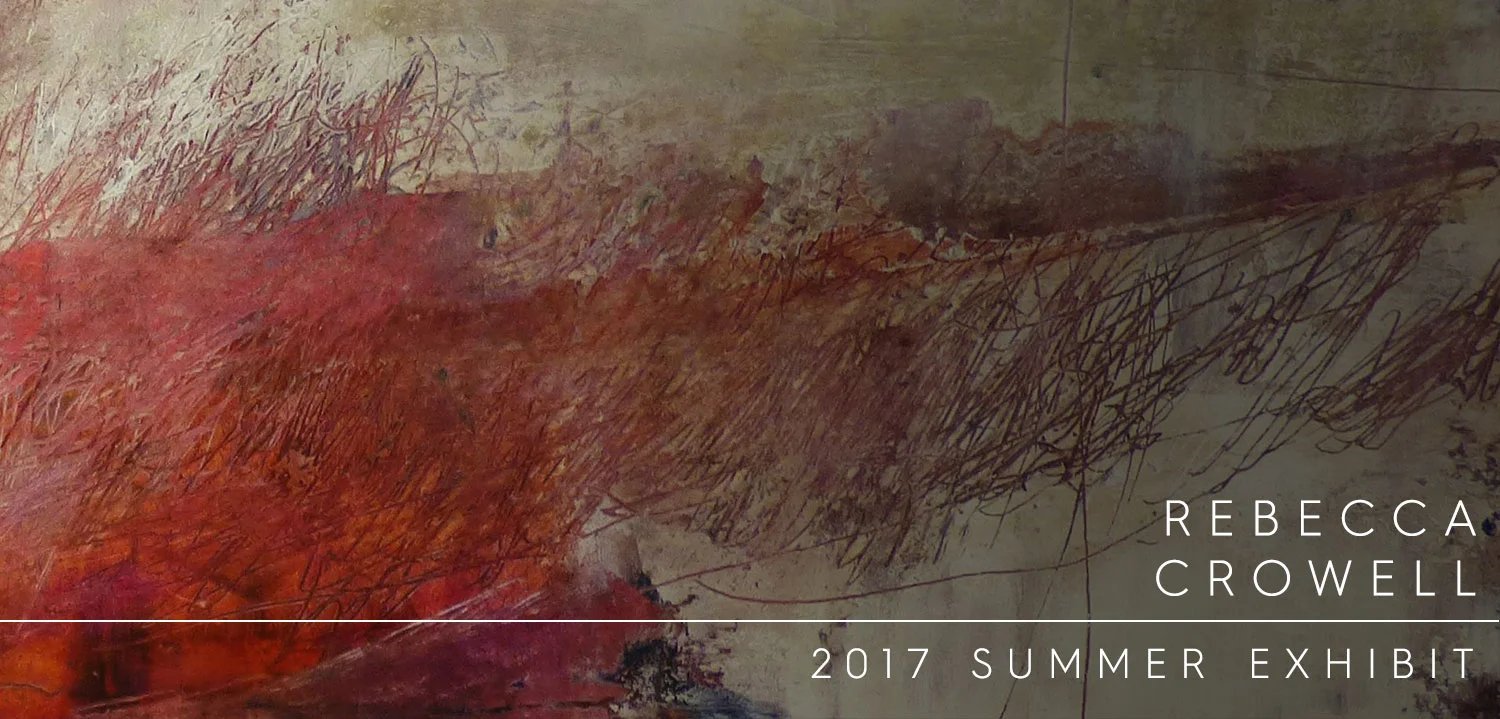
Rebecca Crowell is known for her innovative use of cold wax, in which she layers, scratches, and dissolves the pigmented medium to create textural variety and a sense of depth. While not straightforwardly representational, her works read as cropped portions of mineral surfaces, with fault lines, veins, and calcification, calling up a sense of geological time for her viewers. Crowell is a returning exhibitor with Sager Braudis Gallery, and was kind enough to answer a few questions posed by Gallery Director, Hannah Reeves, about her current work, which will be on view in the Summer Exhibit through July 29th.
REEVES: You’ve been an authority on the cold wax medium for years, teaching workshops and writing about your techniques. How did you learn about it?
CROWELL: Someone at an art supply store asked me in offhand way if I had ever tried it, and it turned out to be the right thing at the right time for me–I was trying to get richer textures into my oil paintings and the medium lent itself to layering, taking imprints and being scraped back. Gradually I discovered lots of ways to use it, sometimes turning to my printmaking background for tools and techniques. It was all about experimenting and trying things out. It took about nine years before I started teaching and putting information online.

REEVES: Are there caveats or tips that you share with emerging artists who think they might want to explore cold wax?
CROWELL: Yes, I encourage beginners to recognize the need for patience—it takes time to understand what the medium is capable of and how to work with its unique qualities. That goes along with the truth that good painting in any medium takes a lot of practice and experience. The qualities of cold wax—its translucency, quick set up time, and ability to hold texture—are unique and beautiful. But I often say the medium itself is not magic. Many beginners are seduced by the interesting effects that can happen right away, but to really progress you need technical skill, a basic understanding of design principles, and clear intentions. That said, the best approach starting out is to play, experiment, explore, and enjoy the process. Just remember that it takes a while to develop a strong and unique voice.
REEVES: How is your creative process related to the ultimate meaning that you want to convey to your viewers through your work?
CROWELL: I would say the creative process goes beyond technique or particular materials, and is really inseparable from our experiences in the world and how we process them. My work comes out of time spent in wild, rugged and sometimes remote parts of the world, and is an attempt to reflect their intricate beauty and raw power. It is about my emotional response to these places, my memories, and a feeling of connection to nature that I feel when I’m there. I think that the layering, texture, and complexity of my work is the result of these responses.
REEVES: Are there movements or artists in art history that influence you, or that you enjoy especially?
CROWELL: I can point to a wide range of art that has drawn me in over the years—from medieval illuminated manuscripts with their delicate detail, to 19th century romantic landscapes, to abstract expressionism, to austere minimalism. One of the most interesting time periods for me was the rise of pure abstraction in Western art, around 1910-1915. I’m fascinated that many of these artists had spiritual ideas at their center, and that the idea of non-referential abstraction arose in different parts of the world at about the same time.

REEVES: It’s always fun to ask: What is your studio quirk?
CROWELL: Well, I am really really messy in the studio. I get teased about it all the time. At the end of the day it usually looks like a tornado came through.