

Featured Artist | Norleen Nosri

Noreen Nosri was born and raised in Malaysia, and immigrated to the U.S.as a young adult in 1996. The family, culture, and rituals of her childhood were never really left behind, but galvanized as a part of her identity even as she learned and acquired her sense of Americanism. Central to her participation in both cultures is connection to community and tradition. Her new work, aptly titled Emigrate / Immigrate, houses a system of symbols that she’s created to stand for the act of migration, and the duality of identity that results from the desire to fully connect and participate in both cultures.
She discovered ceramics when already well into her study of art, after transferring from Columbia College to University of Missouri. She didn’t get into ceramics courses right away; she says, “Seeing those packed courses made me want to take it more. You had to be accepted then, and I was accepted into Ceramics in 1999.” From the beginning of her study of the medium, ceramics reminded Nosri of social interaction and ceremony. “My mom, she has a set, in cabinets, with doors – you look at it, and it is an attraction for the guests. You don’t have to look very far to see the rituals. Look inside your daily life,” she says.
Nosri’s sheer skill is impossible to ignore. Over a decade of intense practice and study has resulted in an extremely refined style and craftsmanship. In her tea sets, every delicate spout, handle, lid, and vessel sits flawlessly in place, the relationships of the forms within a set preconceived and utterly intentional.
Discussion of meaning in Nosri’s work can delve as deep as the interviewer desires. These sculptural sets are thoroughly symbolic and allegorical, and the artist has considered the impact of every detail. Perhaps most prominent is the presence of duality; dark and light, rough and smooth, solid and fragile, masculine and feminine qualities within one set state and restate the presence and importance of two different cultures within the artist’s identity. She says, “I am both and I accept both. Strong tradition is housed in the base – masculine and protective – and a dynamic quality in the pieces that move. Groundedness in the base. Relationship in the tea set. Really, relating is seeing the other side when there are differences.” The tea pieces themselves are like members of a family, living together but capable of movement and different roles. They also signify the social ceremony of serving tea – especially important in her culture of origin – which is, at its heart, about connection between individuals, and connection of its participants to their collective history through tradition and ritual. The base of each set, while providing a counterpoint to the light, fragile, dynamic qualities of the porcelain pieces atop, also bears the form of a boat, symbolizing the act of migration itself.
With characteristic humility, Nosri jokes at the conclusion of our interview, “But, if people don’t want to think about all that symbolism, remember, it’s okay: It’s just a tea set.” Indeed, these sets are fully functional and many of her collectors take pride in serving guests from such vessels. Undoubtedly, it is with a sense of ceremony befitting the work that they do so.

Earthenware, porcelain, and Kintsugi gold leaf
6.5 x 11 x 6
$675
Featured Artist | Bill Dawson
Bill Dawson began carving as a hobby a decade ago. His work, since that time, has transitioned from small to larger, more complex pieces, yet has retained a gentle reverence for the animal forms it depicts, deeply rooted in craft and expertly sculpted. Gallery Director Hannah Reeves asks Dawson about his relationship to his craft in this week’s Featured Artist interview.
Reeves: What was the very first thing you carved from wood? Could you describe the progression of your sculpting since then?
Dawson: I first carved a mourning dove, just because I’ve always loved them. After that I began to turn to larger birds: an avocet, a pileated woodpecker, an ibis, a kingfisher. I still did smaller birds as well. At some time I began doing humorous animals (these not life size): dancing ballet pigs, a pelican in tidy whities (The Pelican Briefs). Later I finally turned to an antelope head (impala) for myself, still just because I like them, and then I made a couple more for [my daughter] Lily’s and my son Joe’s new apartment. That’s about the time Lily began to plant the seeds of making other heads and making them public.
Reeves: Could you describe your method of carving? What is the most challenging part of your process?
Dawson: I learned simply by trial and error. I use craft saws for most of the larger cuts, turning to knives for the details. The two most challenging things are working from a two-dimensional image and turning it into three dimensions. At the beginning that’s a very slow process of cutting away a little, looking it over, then cutting a little more if needed. The second is piecing together the various prongs of a set of antlers (basswood only comes in limited sizes, so it would be impossible to carve an entire head and rack from one piece).
Reeves: Why have you chosen mostly Basswood? How much difference does your choice of wood make in the ultimate product?
Dawson: Basswood’s the standard for carvers. Doesn’t split, easy to work with, yet strong enough to support weight (such as in the kudu on the gallery wall). I have worked with tupelo, a lighter-weight wood, but it’s awfully soft and easily nicked–the dancing pigs stand on one trotter, so they’re awfully top-heavy, so I used tupelo for them.
Reeves: Is there a feeling, thought, or impression you’d like for your work to elicit in its viewers?
Dawson: I’d just like to represent the beauty that’s in nature.
Reeves: What has influenced you as you’ve progressed as a sculptor?
Dawson: Carving animals is an old tradition (especially wading birds), so there are lots of models out there for me to have seen and studied.
Featured Artist | Chris Dahlquist
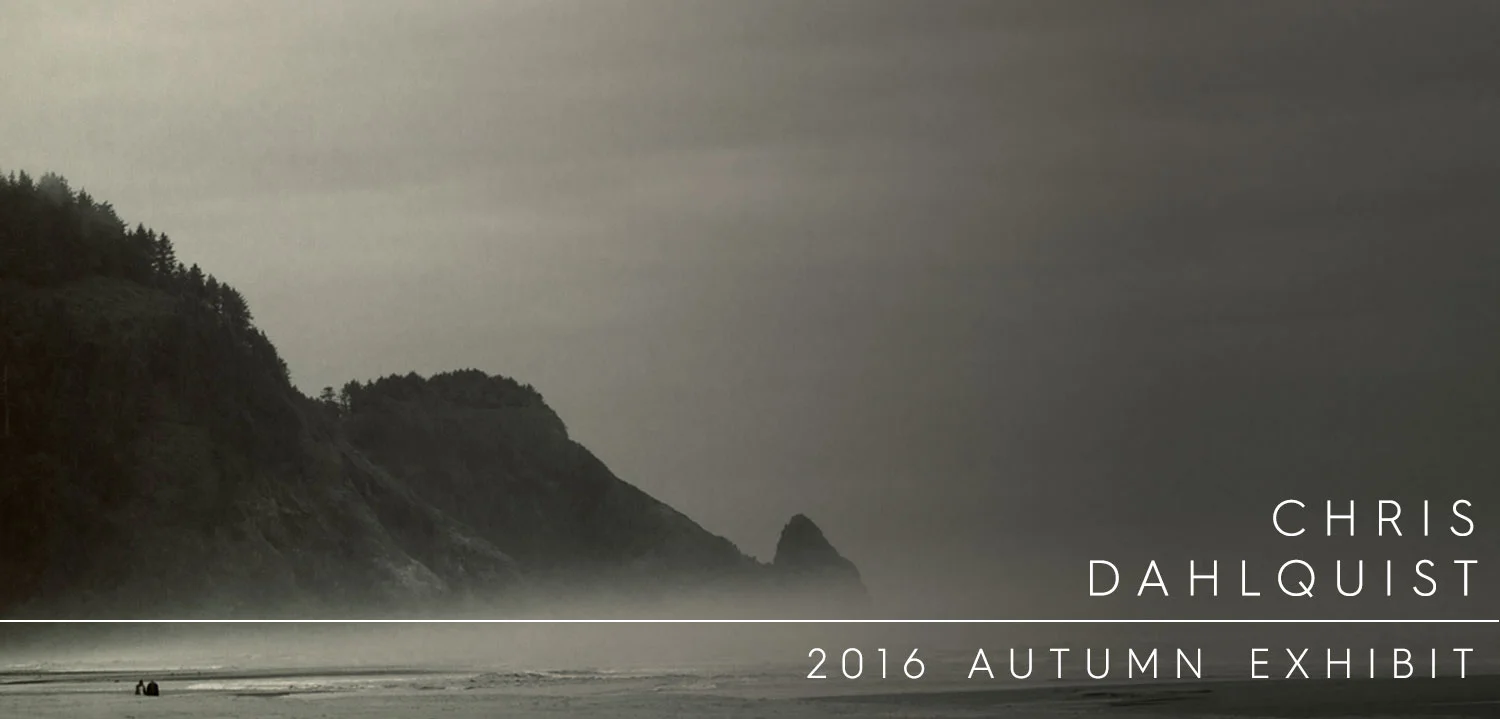
Chris Dahlquist is known for unique and painstaking preparation and presentation of her photographs, adding depth and resonance in each series by printing on specially-prepared surfaces. While at its heart her new work is landscape photography, her capture of temporary, fog- or smoke-obscured scenes, combined with physical translucency and layering of prints, speaks to mystery, stillness, and awe.
Gallery Director Hannah Reeves asks Dahlquist about her medium, method, and concept, and how viewers can approach and understand the new series currently on exhibit.
Reeves: How do you describe your medium? To list it as photography feels overly simple, given your unique process and combination of materials.
Dahlquist: I think of myself as a photographer in the most traditional sense, and only if pushed would I expand my self-identification to include “photographic mixed media artist”. If the word photography alone doesn’t seem to capture my work, it is because our idea of photography has become too narrow, encompassing little more than capturing an image. Originally photography was so much more than that. The early photographers were also by necessity scientists, inventors, and problem solvers, and the materiality and the mark of the photographer’s hand were evident in all photographs.
Reeves: Those familiar with your work will look for a visual reference to historical, photographic processes such as daguerreotype and orotone. Is there such a reference in this new body of work? If so, could you give us a little history?
Dahlquist: The underlying visual reference that runs through all the bodies of work I have created, including Ghost Notes, is the international photography movement known as Pictorialism, which was prevalent from the late 19th to the early 20th centuries. This photographic movement aligned itself very closely with painters, aiming to “create” rather than simply “take” photographs. Visually Pictorialism had much in common with the Tonalist painters of the same time period, and this influence is very apparent in both my Ghost Notes series as well as my Mile Marker series. The mark of my hand can be found throughout all of my work making each work unique despite its photographic origins; similarly the Pictorialists used what they called “ennobling processes” to create original pieces that were sometimes mistaken for drawings or lithographs.
The title of this body is a reference to a musical term. In music, ghost notes are notes that are played but not meant to be heard, with their presence by contrast amplifying the notes around them.
Reeves: In these landscapes, the horizon line, the foliage farthest from the camera, and many of the details of even the foreground are obscured by the haze of either fog or smoke. What drew you to these settings? They’re quite different from the clear, sunlit horizon most associate with the term, “landscape.”
Dahlquist: It wasn’t until Modernism that the sharp clear focus that is now associated with landscape photographs took hold, in no small part due to the popularity of the most well known modernist, Ansel Adams. However, prior to this movement, the Pictorialist photographers often used a soft atmospheric quality to emphasize tone and mood. By concealing detail and context through the smoke and fog, the ambiguity of the images can act as a memory or emotional trigger for the viewer, creating a deeper connection with them beyond documentation of place. While Adams’ and many other Modernists would have you in awe of the natural beauty of the external world, I seek to elicit a quieter internal dialogue.
Reeves: This may seem an odd question to ask of a photographer, but can an image capture what you’re accomplishing in these originals? I feel like people truly have to see them in person to perceive their depth and translucency. Is that true?
Dahlquist: This is absolutely true. Because of the materiality, depth, and translucency of the pieces, they appear very different as one’s viewing angle changes. Because of this a single photograph can never capture and convey what it is to see them in person. The joke in my studio is that with each consecutive body of work I have created, I am a photographer who has managed to create objects that are harder and harder to document in a photograph.

Photograph on Washi paper, cotton rag paper, cold wax
22.5 x 22.5
$950

Photograph on Washi paper, cotton rag paper, cold wax
22.5 x 22.5
$950